Which hose to connect to a submersible pump?

Picking the wrong hose is a common mistake. It slows your submersible pump down, wastes energy, or causes leaks at the connection. Luckily, choosing correctly only takes three checks. This guide walks you through diameter, length, and hose type, step by step.
Quick summary
Match your hose diameter to your pump outlet. Choose a length that reaches your destination without excess slack. Pick a spiral hose for strength, or a flat hose for easy storage. Use the right fitting and material to connect everything without leaks. Follow the steps below to connect your hose correctly.
Match the hose diameter to your pump
Important rule: The hose diameter should always be at least the same as the pump outlet, or preferably larger. Standard submersible pumps need a hose with a minimum diameter of 25 mm (one inch). A standard garden hose is only 13 mm wide — too narrow for most submersible pumps.
A narrower hose slows the water flow. Your pump then works harder to move the same amount of water, and uses more energy doing it, which raises your running costs over time. For example, a pump moving 10,000 litres per hour needs a one-inch hose to reach full capacity, so always check your pump's outlet size before you buy.
Choosing the right hose length
Measure the distance from your pump to where the water needs to go. Then add a little extra length for slack. If your well is 10 metres deep, choose a hose of at least 12 metres. This lets it reach the surface comfortably, with room to connect it at both ends. Getting this measurement right the first time saves you a return trip to the shop.
A hose that is too long reduces water pressure. Your pump then has to work harder to push water through the extra length. Choose a length that covers the distance, without adding unnecessary extra metres. This keeps your pump running efficiently, and helps it last longer too.
Spiral hose or flat discharge hose?
Your two main options are a spiral hose and a flat discharge hose. Each one suits a different job, so think about how and where you'll use it.
Spiral hose: its coiled structure bends and moves without kinking. This suits jobs where you move the hose often, or need strong water flow.
Flat discharge hose: lies flat for easy storage and quick set-up. This makes it ideal for draining a flooded space or emptying a pool fast. It does handle less pressure, though, so keep that in mind for heavier jobs.
Connect your hose to the pump in 4 steps
Follow these steps to connect your hose safely and avoid leaks.
Check that your pump outlet and hose share the same diameter. If they differ, use a reducing socket or reducing nipple to bridge the gap.
Choose your fitting type. A screw coupling suits a permanent, high-pressure connection. A click/snap coupling suits a hose you disconnect often.
Match the thread type. An internal (female) thread fits inside an external (male) thread. Think of it like a nut and bolt.
Wrap PTFE tape around the thread before you tighten it, to make the connection airtight. Then tighten by hand, and check it with a wrench. A snug fit stops leaks under pressure.
Which fitting do you need?
If your pump outlet and hose share the same diameter, a one-inch screw coupling gives you a durable, secure connection. This suits a system that runs under constant pressure.
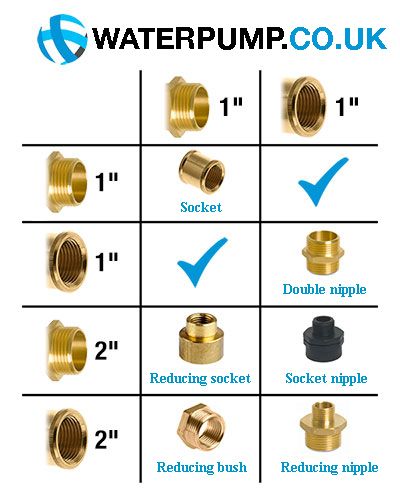
If the diameters differ, use a coupler instead. Here's which one you need:
A socket connects two hoses or pipes that both have an external (male) thread.
A reducing socket connects two hoses or pipes with different diameters.
A socket nipple connects an external-thread hose to a fitting with an internal thread.
A double nipple connects two components that both have an internal thread, such as two sockets.
A reducing bush adapts a connection between two different thread sizes, with an internal thread on one end and an external thread on the other.
A reducing nipple connects two different thread sizes, with an external thread on both ends.
Brass or plastic fittings: what's the difference?
Brass fittings resist rust and corrosion, even with hard water. This means they last longer, and handle pressure and temperature changes without wearing out. You end up replacing them less often. This saves you money over the life of your pump. Brass is the safer choice for a system that runs under constant pressure.
Plastic fittings cost less and never rust, which makes them a good budget option. They handle heat and pressure less well than brass, though. This makes them better suited to lighter, everyday jobs than to heavy-duty or high-pressure setups. If you're only running your pump occasionally, plastic is often all you need.
Need help choosing?
With the right diameter, length, and fittings, your submersible pump runs efficiently and stays leak-free. Still not sure which hose or fitting fits your setup? Our customer service team is happy to help you find the right match.
Common questions about connecting hose to submersible pump (FAQ)
Here are quick answers to the questions we hear most connecting your hose to your submersible pump.
Related reads
Want to get more out of your pump? These guides cover more connections and common issues.