




What type of central heating pump do I need? [Complete list]

Are you facing the challenge of choosing a new central heating pump ? This is not an easy decision, because your personal comfort during the cold winter months depends on it. The wrong choice may result not only in you feeling cold but also in high energy bills. In this blog, we have therefore put together a complete, step-by-step overview to help you select the perfect central heating pump for your situation. Read on to learn which central heating pump will keep your home warm and energy efficient.
Back to basics: What does a central heating pump do?
Any home or building with radiators or an underfloor heating system is equipped with a central heating pump or an underfloor heating pump (also known as a circulating pump, circulation pump or circulator pump ) that provides hot water to the system. This essential device ensures that heat is distributed efficiently throughout the house, which not only improves comfort but also increases energy efficiency and saves energy costs.

Key concepts for choosing the right central heating pump
It is good to be aware of certain key concepts that apply to circulator pumps. We will discuss these briefly before looking into the step-by-step instructions for choosing the right model circulating pump.
Flow rate (or pump capacity)
This refers to the maximum amount of water per hour the pump is capable of processing. This capacity is often expressed in terms of litres per hour (l/h) or cubic metres per hour (m3/h)
Too low a flow rate results in inadequate heating;
Too high a flow rate results in energy waste.
Delivery head (and pressure)
This refers to the maximum height at which water can be transferred by a pump, which equals the pressure at which the water is processed. For example, a delivery head of 40 metres equals a pressure of 4 bar.
Insufficient delivery head results in cold spots in the house.
Variable or fixed capacity
Modern circulation pumps have a variable capacity, and therefore use less energy. These pumps adapt their speed automatically on the basis of demand. This makes them more efficient than older fixed-power models that run continuously, wasting energy.
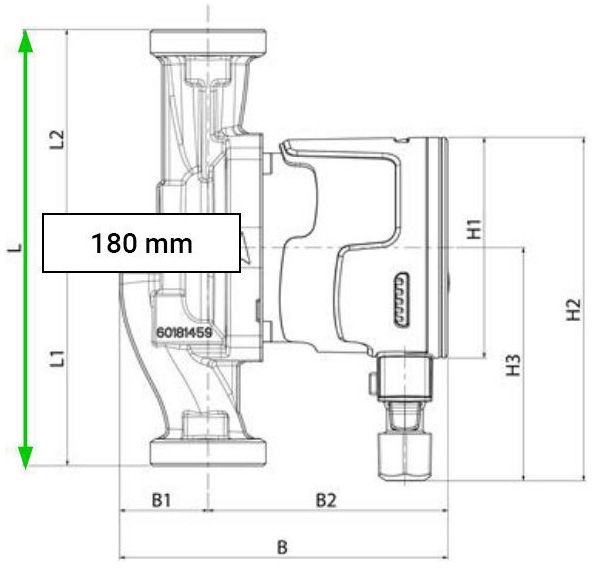
Installation dimensions (130 mm or 180 mm)
This refers to the distance between the connections of the circulating pump. Standard installation dimensions are 130 mm or 180 mm.
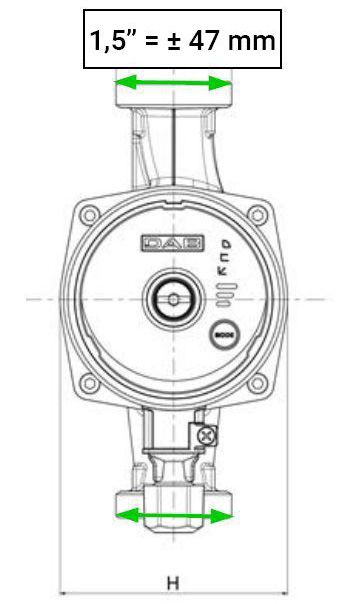
Screw connection (1", 1½" or 2")
This refers to the connector used to connect the circulating pump to the pipes in a secure and leakproof manner . Common sizes are 1" (32 mm), 1½" (47 mm) or 2" (59 mm).
Energy label
This indicates the pump’s energy efficiency. A pump with an ‘A’ label is the most energy efficient while a ‘D’ or ‘E’ label indicates a higher energy consumption.
*Based on an average electricity price of £ 0.36/kWh (August 2025).
| Energy label | Consumption in kWh/year | Cost in £ * | Consumption compared to D/E |
|---|---|---|---|
| A | 50 - 110 | £18 - £39.60 | 60% to 80% less |
| B | 110 - 160 | £39.60 - £57.60 | 40% to 60% less |
| C | 160 - 240 | £57.60 - £86.40 | 20% to 40% less |
| D/E | 300 - 450 | £108 - £162 | - |
Now that you are familiar with the key concepts, we can move on to selecting the right central heating pump for your situation.
Step-by-step instructions: How to choose the right central heating pump
A wide range of central heating pumps are available on the market, which can make the choice complicated. The following step-by-step instructions are designed to help you choose a suitable circulating pump.
Important: Please do not skip Steps 3 and 4, or you could end up ordering a pump that does not fit.
Step 1: Identify the brand of your current pump
This is usually indicated on the front of the circulating pump. Common brands include: Grundfos, Wilo, DAB, Salmson, and Biral.
Step 2: Identify your current pump type
Check these details on the pump’s type plate that is usually attached on top or at the side of the it or is shown on the packaging.
Step 3: Measure the installation dimensions of your current pump
In other words, measure the distance between the connections. The installation size is crucial for the device to fit properly within the system and is usually 130 mm or 180 mm.
Step 4: Measure the diameter of the screw connection of your current pump
The diameter is often 1" (32 mm), 1½" (47 mm) or 2" (59 mm) and determines the size of the pipe through which the water flows.
Step 5: Use our replacement guide
We have created a handy tool that can help you replace your current circulating pump: the replacement guide. With this guide, you will quickly be able to find a suitable replacement model.
Replacement guide: choose the brand of your current pump


Please note: Although our list has been drawn up with the utmost care, inaccuracies or omissions may occur. We will do everything necessary and as soon as possible to correct any inadvertent inaccuracies.
Step 6: Check the physical properties of the recommended pump or pumps
Check that the installation dimensions and screw connection match those of your current pump.
Step 7: Select your new circulator pump
If you are certain that the specifications of the old and the new pump match, you can make your choice based on brand, price, and reviews.
The circulation pumps in our range
Our circulation pumps from brands such as DAB and Grundfos are often suitable replacements for older models. They have an ‘A’ energy label and are speed controlled, which ensures an average saving of 70% in annual energy costs. In many cases, a new model pump pays for itself within one year.
People often contact us only after their current pump has broken down. However, it can be highly beneficial to replace your pump before this happens . Start saving now with a new DAB or Grundfos pump.
A circulator pump for a completely new central heating system
If you install a completely new heating system, you will also need a circulator pump. In that case, choosing the right pump may be more difficult, because you need to understand the following:
Required capacity (flow rate), which depends on the amount of water that needs to flow through the system to meet the heat demand;
Delivery head (pressure loss) in metres, which depends on the length and diameter of the pipes, the number of bends, and other kinds of resistance.
Owing to the complexity of an entirely new central heating system, we recommend contacting our expert customer services team for help in choosing the right pump.

